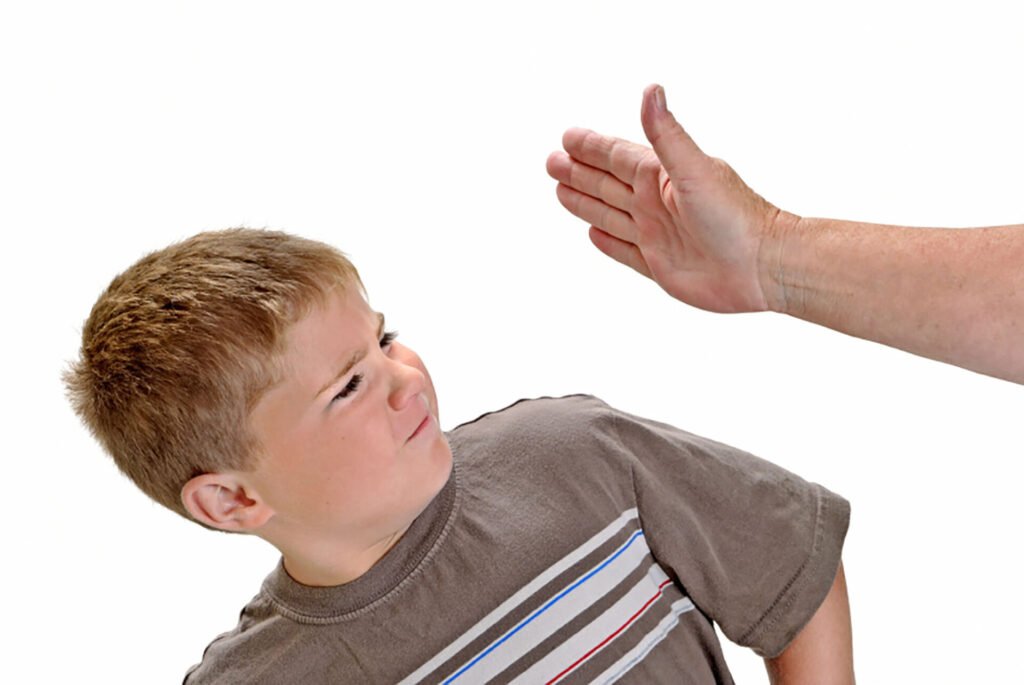
Smacking children as a form of punishment could result in lower school grades or lead to riskier teenage behaviour, a study has found.
Researchers from the University College London (UCL) studied the impact of physical punishment on 19,000 children born in the UK between 2000 and 2002, at ages three, five and seven.
They observed that smacking “does no good whatsoever” and have called for England and Northern Ireland to outlaw it, in line with Scotland and Wales.
The Department for Education in England said the government had no plans to change the law on smacking, but that the safety and well-being of children was a government priority.
Lead researcher, Associate Professor Anja Heilmann, said the research found smacking “does not help children and all the effects that we did find were in the direction of a harmful outcome”.
As part of the research on the 19,000 children, the team reviewed 7,559 GCSE students in England against the National Pupil Database to determine their exam scores.
It was observed that those who had been smacked saw the likelihood of them failing to get five pass grades (A*-C) at GCSE level, including English and Maths, increase by 5.7 percentage points.
The study also found that 14-year-olds who had experienced physical punishment in early childhood were 33% more likely to engage in risky behaviours, including bullying.
Heilmann said: “My hope is that smacking stops in the UK so children have the same protection from physical assault that adults have.”
The study was observational, meaning researchers compiled results from questionnaires completed by families of children who had been physically punished.
However, there analysis could not prove a direct link between smacking and the results, as other factors might have influenced a child’s life over the research period.
Scotland became the first part of the UK to outlaw physical punishment of under-16s, with a ban on parents smacking their children becoming law in 2020. Wales followed suit in 2022, but in Northern Ireland and England, it is still legal.
Some argue a ban would offer young people legal protection against assault, while others say it could criminalise parents.
Amy Woods, the owner of Baby College in Salford, said she wants to see a ban in England and “couldn’t believe that there wasn’t one already”.
“Children need warmth, they need responsive relationships, and they need play to thrive, definitely not violence at a young age,” she said.
Sarah, who attends the playgroup with her 10-month-old son Joshua, said she was also surprised that smacking was still legal.
“I don’t think it’s a very good example to be setting to kids,” she said. “If they do something wrong, like hit someone, and you smack them back, it doesn’t really reinforce the message of ‘this isn’t ok’.”
But Prof Ellie Lee, a family and parenting researcher at the University of Kent, said while the results of the UCL study sounded “plausible” there was a “rush to try and find silver bullets and single causes, when most things that happen as part of child development are relatively multifactorial”.
Lee, who is also part of the Be Reasonable England campaign which supports the use of smacking, said: “It would be great if we could just be nice to children and think they would just be nice back.
“But the reality of it is, is that in order for children to understand the rules of society, and to learn how to behave in a way that is moral, and that is good, we have to have boundaries, and boundaries have to be backed up.”
The UCL study also found that one in five 10-year-olds had been physically punished in some way when monitored in 2021 and mothers with higher education levels were less likely to use physical punishment.
The Northern Ireland executive was contacted for comment, but is yet to respond.
source: BBC