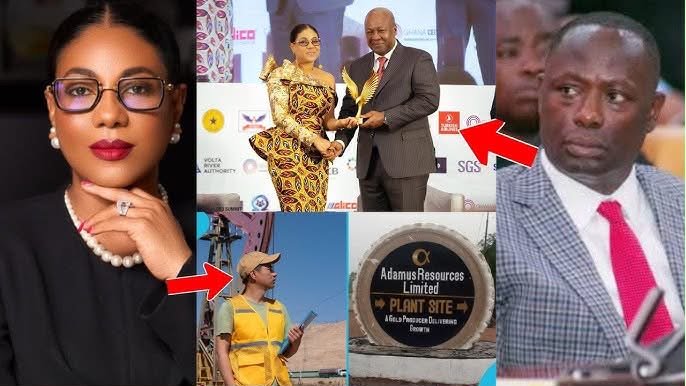
The battle for control over the Adamus Nzema gold mine has rapidly escalated from a corporate squabble into a defining test of political patronage versus regulatory probity in Ghana. At its heart lies a fundamental question: will the state enforce the rule of law against well-connected elites, or will partisan affiliation continue to dictate the outcome of multibillion-cedi disputes?
The controversy pits Adamus Resources Pty Ltd (Adamus Australia), the lawful 90% owner of the Ghanaian subsidiary, against Angela Diala List – daughter of National Democratic Congress (NDC) stalwart Daniel Abodakpi – and her Mauritian vehicle, Nguvu Mining Limited. The latter stands accused of executing an unlawful corporate hijacking using fabricated meeting minutes and unauthorised signatories.
The Australian Vindication
In a decisive ruling, the Supreme Court of Western Australia declared List’s 2022 attempt to remove Allan Morrison – the sole director and secretary of Adamus Australia – unlawful. The court confirmed that List had no authority to alter the governance of the Australian parent or its Ghanaian subsidiary. Her appointed nominees, Kevin Woodthorpe and Peter Michael, subsequently abandoned their posts. This judgment established a clear legal baseline: any subsequent transfer of shares purportedly executed by List’s proxies was legally void.
Regulatory Failure in Accra
Despite being formally notified of the Australian parent’s objections, Ghana’s regulators moved in the opposite direction. On 23 December 2022, the Minerals Commission, acting on a letter signed by then Lands Minister Samuel Abu Jinapor, formally recognised Nguvu Mining as the new controller of Adamus Ghana. Four days later, the Registrar of Companies recorded Nguvu as the 90% shareholder. Both approvals were granted without consulting Adamus Australia or independently verifying the authority of Moses Kobina Bosompim, who had purportedly signed the transfer documents.
This regulatory lapse enabled Nguvu to operate the mine for nearly four years, during which period investigations uncovered substantial violations. Under the disputed management, Adamus accumulated $2.56 million in unpaid mineral rights fees, GH₵86.8 million (approx. $7.6 million) in unpaid royalties, and GH₵290.5 million (approx. $25.4 million) in tax arrears. Auditors also flagged unexplained discrepancies in gold exports and transfers of approximately $224 million to related parties abroad between 2020 and 2024. Allegations have further emerged that portions of the concession were allocated to illegal miners, including foreign nationals.
The Political Calculus and the Wontumi Precedent
The timing of the Mahama administration’s intervention is telling. On 26 April 2026, Lands Minister Emmanuel Armah-Kofi Buah revoked the three mining leases. An independent review upheld that decision in August. Yet, on 21 August, the Presidency announced a dramatic about-turn, offering a 12-month “recovery roadmap” and a six-member joint management team split equally between the company and the state.
This reprieve stands in stark contrast to the government’s vigorous prosecution of Bernard Antwi Boasiako (Chairman Wontumi), the Ashanti Regional NPP chairman, who recently received a 20-year sentence for illegal mining. Critics argue the disparity exposes the partisan calculus underpinning the anti-galamsey crusade: zero tolerance for opposition figures, but executive clemency for the offspring of NDC royalty.
The Shadow of the Former Attorney General
Adding to the intrigue is the role of former Attorney General Godfred Yeboah Dame. While in office, his ministry had oversight of the Registrar of Companies, yet no action was taken to halt the irregular share transfer. Dame is now reported to be acting as counsel for List and Nguvu Mining in related civil proceedings. While not evidence of wrongdoing, this sequence raises legitimate questions about prior official knowledge and potential conflicts of interest.
Unanswered Questions
The Presidency’s reprieve has created more confusion than clarity. Which entity is the government recognising as “Adamus” the Australian owner vindicated by the courts, or the Mauritian entity created through disputed filings? Why are individuals accused of fraud being permitted to nominate half the oversight team before the ownership dispute is resolved? And why has the state granted a lifeline before recovering the hundreds of millions in outstanding taxes and royalties?
The Criminal Investigations Department (CID) is reportedly facing scrutiny over delays in its investigation. Director General Lydia Yaako Donkor must explain whether prosecutorial advice has been sought. Meanwhile, lawyer Kwaku Sarpong Odame faces disciplinary proceedings before the General Legal Council for his alleged role in the fabricated shareholder meetings.
A Test of Governance Credibility
For President Mahama, the Adamus affair represents his first major governance test. His administration has cultivated a public image of discipline and transparency. The NDC previously capitalised politically on the NPP’s indulgence of Akonta Mines. Applying a different standard to Adamus a company with direct ties to the ruling elite would irrevocably damage the government’s credibility and signal to international investors that Ghana’s corporate registry remains vulnerable to political capture.
Ghana’s mineral wealth belongs to its people. Adamus Australia, as the lawful owner, has been vindicated by the Australian judiciary. The government’s reprieve offers a rare opportunity to correct past regulatory failures, recover lost state revenues, and restore lawful control. But if the state chooses instead to legitimise an unlawful takeover to shield political allies, it will have sent a dangerous message: that in Ghana, the colour of one’s party card determines the application of justice. The international community and Ghanaian electorate are watching closely.