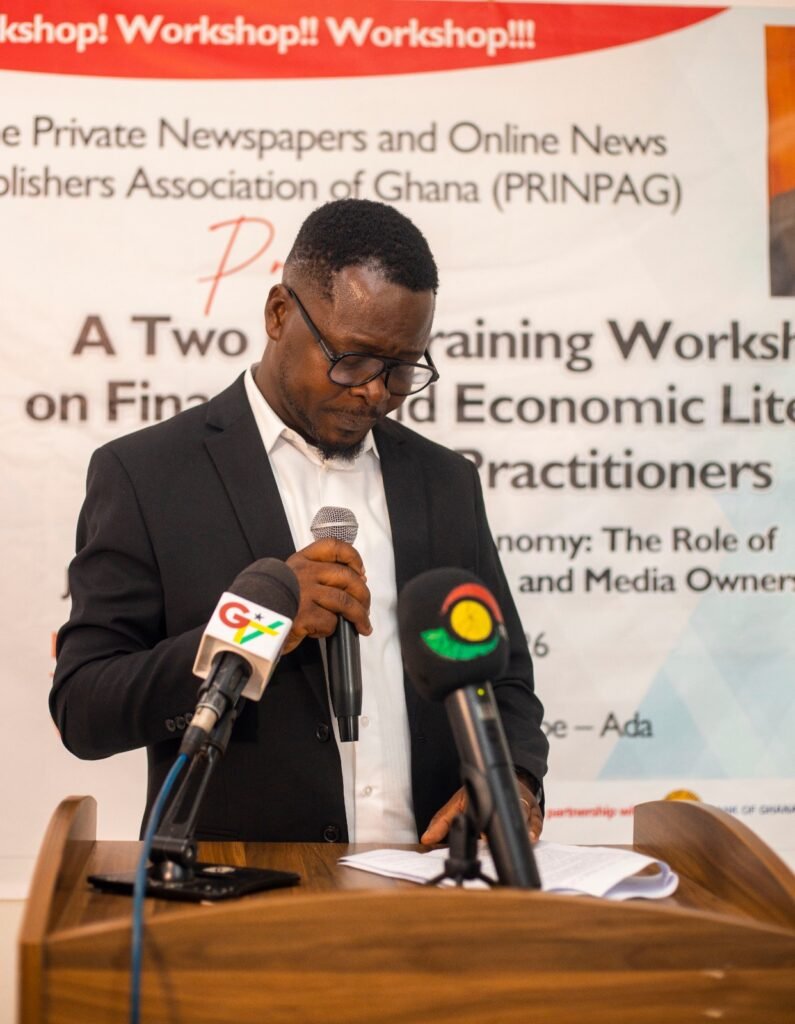
The Private Newspapers and Online Publishers Association of Ghana (PRINPAG), in partnership with the Bank of Ghana, is holding a two-day capacity-building workshop aimed at strengthening economic and financial reporting by media practitioners.
According to PRINPAG President David Sitsopé Tamakloe, the workshop is intended to equip journalists with the knowledge and skills required to accurately interpret and report on Ghana’s economic developments, particularly in the context of monetary policy, inflation, foreign exchange, and financial sector reforms.
Delivering a welcome address on January 24, David Tamakloe said the workshop was not a routine engagement but a direct outcome of earlier discussions between PRINPAG and the leadership of the Bank of Ghana at the New Year Media Engagement.
He explained that the workshop brings together 45 participants, comprising 44 media professionals and one media consultant, under the theme: “Resetting the Economy: The Role of the Journalists, News Publishers, and Media Owners.”
“We heard, clearly and unequivocally, the Governor’s commitment to deepening collaboration and expanding training for media practitioners.
We also absorbed the First Deputy Governor’s powerful reminder that in today’s economy, ‘communication is policy,’ and that our reporting carries the weight of shaping expectations, confidence, and ultimately, market stability,” he said.
Mr. Tamakloe noted that the engagement marks a shift from dialogue to practical capacity building, with the curriculum focused on accuracy, balance, context, and a deeper understanding of complex monetary policy tools.
“Today, we move from dialogue to actionable capacity. The themes laid out by the Bank’s leadership the necessity for accuracy, balance, and context; the understanding of complex monetary policy tools; the profound impact of financial reporting on the lives of households and businesses form the very bedrock of this workshop’s curriculum.”
He added that the training is designed to help journalists better interpret the Bank of Ghana’s data-driven decisions, analyse its emphasis on stability, and report on institutional reforms as interconnected steps towards consolidating Ghana’s economic recovery.
Reflecting on the economic trajectory of the past year, Mr. Tamakloe said the role of the media has become increasingly critical.
“The year 2025, as detailed by the Governor, was one of difficult but necessary adjustment, restoration, and hard-won stability. As the media, our role in that period was acknowledged as essential. As we look to 2026 a year dedicated to ‘consolidation and discipline’ our role becomes even more critical. The stability achieved must be explained, protected, and nurtured by a media corps that is informed, responsible, and cognisant of its shared national responsibility,” he said.
He described the workshop as a key step in strengthening the relationship between the media and the central bank.
“This workshop is a cornerstone of that mission. It represents a strengthening of the partnership between the Fourth Estate and a key pillar of our nation’s economic architecture. It is an investment in ensuring that our reporting on inflation trends, foreign exchange mechanisms, banking sector resilience, and digital finance innovations does not merely inform, but also educates and stabilizes,” he said.
Mr. Tamakloe urged participants to actively engage in the sessions and make full use of the opportunity provided by the Bank of Ghana.
“Let us therefore engage fully in the sessions ahead. Let us ask the probing questions. Let us seek the clarifications that will turn complexity into clear public understanding. The Bank of Ghana has opened its doors and committed its experts to this process; let us honour that commitment with our utmost attention and participation,” he said.
He further encouraged media practitioners to apply the knowledge gained to improve the quality and impact of economic reporting in Ghana.
“To the resource persons from the Bank of Ghana and other disciplines, we thank you in advance for your insights. To my colleagues in the media, I urge you to seize this opportunity to build your capacity, so we can collectively tell the Ghanaian economic story with greater depth, integrity, and positive impact,” he added.