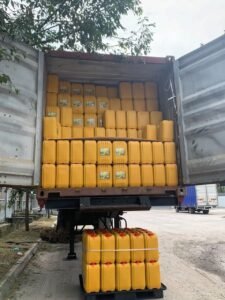
The Office of the Special Prosecutor (OSP) has launched an investigation into a suspected corruption scheme involving the diversion of 50 containers of palm oil valued at GHS25.8 million.
In a statement issued on February 24, 2026, the Office reported,
“The Office of the Special Prosecutor (OSP) is investigating suspected corruption involving the diversion of fifty(50) twenty-foot containers of palm oil valued at GHS25.8 million.”
According to the statement, the consignment had been declared as goods in transit to Burkina Faso but was instead diverted into the local market.
“The consignment, declared as in transit to Burkina Faso, was unlawfully diverted into the local market without payment of applicable duties and taxes.”
The Office disclosed that preliminary findings point to the involvement of state officials and private actors.
“The Office has identified the involvement of some Customs officers, National Security operatives, and clearing agents in a corrupt scheme that resulted in an estimated loss of GHS10.5 million in taxes. The Office commenced the investigation on the back of an intelligence-led operation conducted in November 2025.”
It added that investigations are ongoing and reaffirmed its mandate to safeguard public funds.
“As the process continues, the Office remains committed to protecting the public purse and upholding integrity.”
The investigation centres on what authorities describe as “transit diversion”, a tactic where goods imported into Ghana are declared as destined for landlocked neighbouring countries such as Burkina Faso or Niger to avoid paying local import duties.
In this case, the 50 containers of palm oil worth GHS25.8 million were allegedly released into the Ghanaian market without payment of the required taxes.
The palm oil case forms part of a broader crackdown on alleged tax evasion schemes involving food imports.
In related operations conducted in February 2026, authorities intercepted 18 trucks carrying cooking oil and tomato paste, uncovering a separate GHS85.3 million tax evasion scheme.
Earlier this year, the Oil Palm Development Association of Ghana threatened nationwide protests, warning that the local market was being inundated with smuggled oil, a situation they said was severely affecting domestic producers.
The scale of the diversions prompted Finance Minister Cassiel Ato Forson to impose an immediate ban on land transit for cooking oil.
Under the directive, such goods are now required to enter and exit Ghana exclusively through designated seaports to strengthen oversight and reduce revenue leakages.