
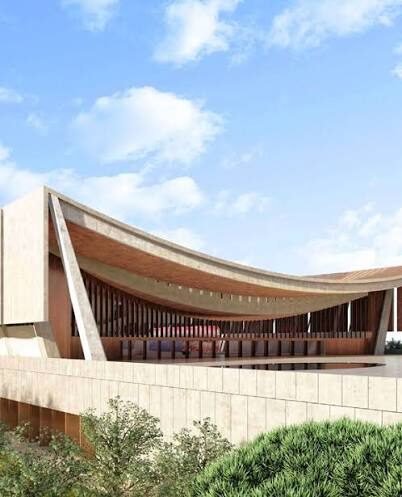
Advocate for Liberation and Development Theology Dr. Benjamin Anyagre Aziginaateeg has questioned why Ghana’s churches failed to mobilise Christian professionals to execute the National Cathedral project without relying on public funds.
According to him, although the vision to build a house for God is admirable, the process adopted raises serious spiritual and moral concerns about sacrifice, transparency and accountability.
“The desire to build a house for God is, in itself, noble and praiseworthy. Throughout Scripture, building for God has always been an act clothed in reverence and purity of intention,” he stated.
“Yet the current debate invites us to reflect deeply on whether the approach to such a sacred task has matched the purity of its intention.”
Mr Aziginaateeg argued that biblical precedents show that God places greater value on integrity and selflessness than on the scale of what is built.
“Would God not be pleased with a clean, transparent, and selfless approach to building His house? A good idea, no matter how divine it appears, must rest on a spiritual foundation of truth, humility, and sacrifice,” he said.
Drawing parallels from Scripture, he referenced Jesus’ choice of committed professionals who willingly abandoned personal gain in pursuit of a higher calling.
He noted that Jesus Himself began the expansion of the Kingdom using seasoned professionals who thought highly skilled, left the comforts and benefits of their trades and followed Christ even unto death.
He also cited the rebuilding of Jerusalem under Nehemiah as a model of communal sacrifice rather than state-funded construction.
Raising questions about the National Cathedral, Dr. Benjamin Anyagre Aziginaateeg asked why similar principles were not applied in Ghana.
“Couldn’t the highly renowned professionals involved—already blessed in their professions—have offered their skills as a sacrificial gift unto God? Did they have to charge fees for a project intended to symbolize national faith, unity, and devotion?”
He further questioned why church leadership bodies failed to coordinate a faith-led approach that could have avoided public funding.
“The Catholic Bishops Conference, the Christian Council, and the Pentecostal and Charismatic Council—with their vast networks of educated, Spirit-filled professionals—could mobilize a national pool of architects, engineers, artisans and financiers who would volunteer to see the dream realized without draining public coffers.”
To support his argument, he cited the work of architect Lawrence Ndaago Ayagiba, who designed and supervised multiple church projects without charging professional fees.
Architect Lawrence Ndaago Ayagiba, designed the Roman Catholic Church – Corpus Christi, Sakumono and the Good Shepherd Parish Hall building at Tema West, and supervised the constructions at no cost.
Dr. Aziginaateeg suggested that a coordinated volunteer approach could have prevented the controversy surrounding the reported $400 million spent on the Cathedral project.
“Would it not have been spiritually—and financially—sound to engage a ‘Consortium of Christian professionals’ to execute the National Cathedral at no cost? Could volunteer-driven fundraising, paired with expert contributions from the body of Christ, not have prevented the public uproar now accompanying the $400 million expenditure?”
He added that it is mind boggling that almost one-fifth of the International Monetary Fund’s (IMF) Two billion dollar support appeared to be consumed by this project.
“If nearly $100 million is spent on 10% of the project, with $400 million earmarked for completion, then it could finally run into billions—funds that could transform the lives of congregants struggling with unemployment, healthcare costs, and basic livelihood challenges.”
He backed ongoing investigative and accountability efforts by the government regarding the Cathedral.
“It is therefore imperative that government continues its forensic review of state expenditures related to the Cathedral—not out of malice, but in pursuit of truth.”
Dr. Benjamin Anyagre Aziginaateeg described the controversy as a moment of spiritual reckoning for the Church.
“Perhaps the real question is this: Has the modern Church unknowingly drifted from the spirit of sacrificial service that once defined its strength? The Cathedral debate is more than a national issue—it is a spiritual mirror.”